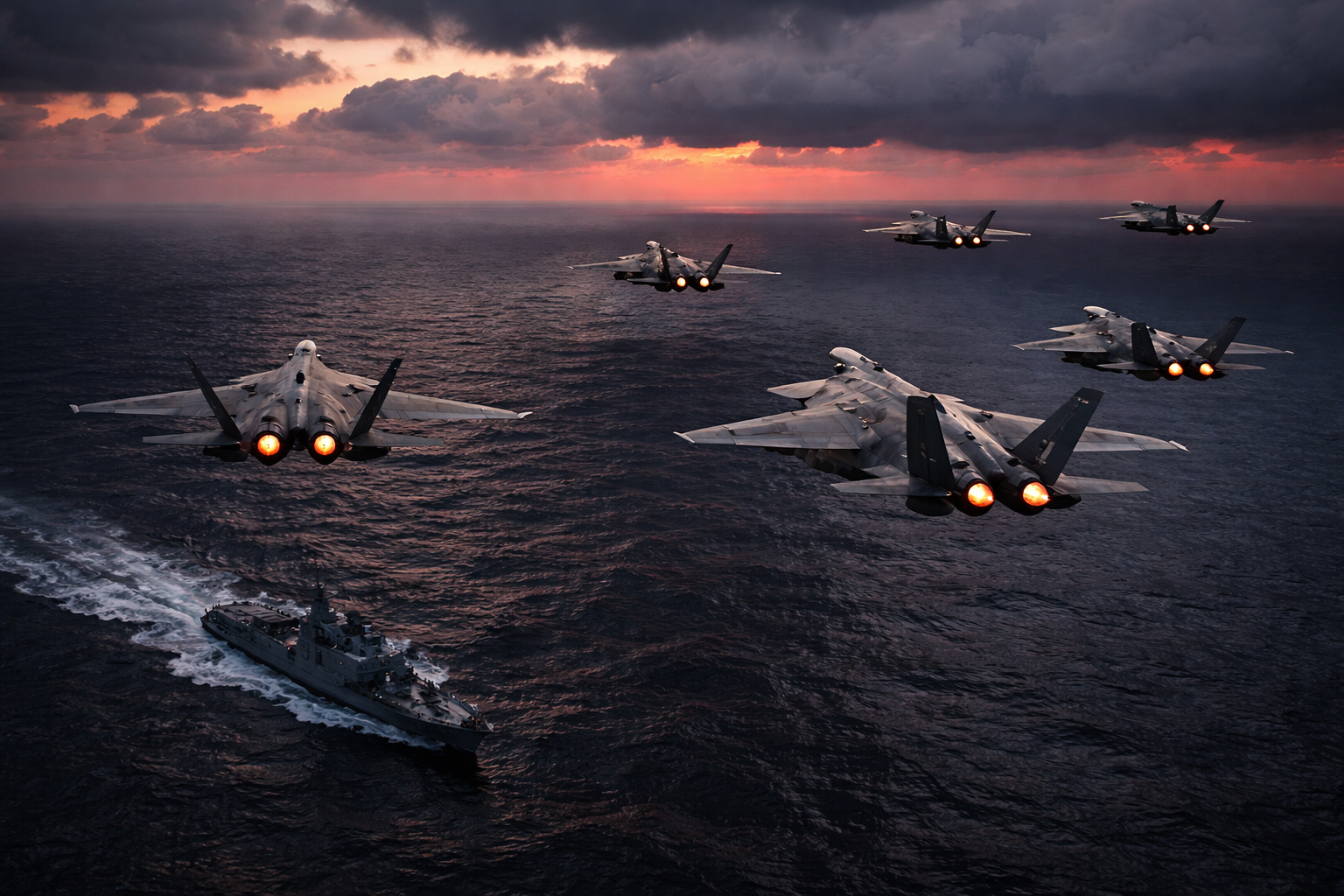
📸 Featured Image Note: The featured image is an AI-generated illustration created to represent the military scenario analyzed in this article. It does not depict actual operations from Justice Mission 2025 drills.
“China’s Taiwan Military Drills 2025: Justice Mission Analysis”
China deployed 130 warplanes and conducted live-fire exercises around Taiwan in “Justice Mission 2025″—the sixth major escalation since 2022. Discover what triggered these drills, why global semiconductor supply chains are at risk, and what this means for Indo-Pacific stability.
In the final days of 2025, the Taiwan Strait became the epicenter of one of the year’s most significant military confrontations. China launched a massive two-day show of force code-named “Justice Mission 2025,” deploying 130 warplanes, 22 naval vessels, and live-fire rocket systems to encircle Taiwan in what Beijing described as a “serious warning” against separatism and external interference. For students and professionals seeking to understand global affairs, this event represents far more than regional saber-rattling—it’s a flashpoint that could reshape semiconductor supply chains, disrupt trillions of dollars in trade, and test the limits of great power competition in the Indo-Pacific.
The timing was no coincidence. Just ten days earlier, the United States announced an $11.1 billion arms package to Taiwan—potentially the largest single military sale in the unofficial relationship between Washington and Taipei. Beijing’s response came swiftly and dramatically, with the People’s Liberation Army mobilizing army, navy, air force, and rocket units in what military analysts describe as the most explicit rehearsal yet for enforcing a blockade of the self-governed island. Understanding this escalation requires examining not just the military maneuvers themselves, but the economic vulnerabilities they expose and the strategic calculations driving all parties involved.
Justice Mission 2025: Anatomy of a simulated blockade
The military exercises that unfolded on December 29-30, 2025 represented a significant escalation in both scope and explicitness of intent compared to previous drills. China’s Eastern Theater Command deployed forces across five designated maritime and airspace zones surrounding Taiwan, conducting what Beijing characterized as combat readiness patrols focused on “blockade and control of key ports and critical areas.” The drills ran from eight in the morning until six in the evening local time on the second day, featuring live-fire exercises, simulated precision strikes, anti-submarine maneuvers, and coordinated air-sea operations.
The scale of the operation spoke volumes. Taiwan’s Defense Ministry reported 130 warplanes and 22 ships participating in a twenty-four hour period—the second-highest number of fighter jets China has deployed around the island, surpassed only by a record 153 aircraft during October 2024 drills. The People’s Liberation Army’s long-range artillery units in Fujian Province fired live rounds toward target zones positioned forty-four kilometers from Taiwan’s northern coast, while rocket units launched seven projectiles into designated drill areas that Taiwan considers within its territorial waters.
What distinguished these exercises from earlier demonstrations was their explicit focus on what military strategists call anti-access and area denial capabilities. William Yang, senior analyst for Northeast Asia at the International Crisis Group, explained to Al Jazeera that the drills were designed to ensure Taiwan cannot receive supplies from allies like Japan and the United States during a conflict. The command deployed destroyers, frigates, fighters, bombers, and unmanned aerial vehicles alongside long-range rockets to practice sealing off the island—a capability that would prove devastating in any actual confrontation given Taiwan’s near-total dependence on imports for energy and critical materials.
The trigger: America’s $11.1 billion commitment
The proximate cause of Beijing’s military response was unmistakable. On December 18, 2025, the United States State Department announced approval for eight separate weapons packages totaling $11.1 billion in potential sales to Taiwan. The package included eighty-two High Mobility Artillery Rocket Systems known as HIMARS, four hundred twenty ATACMS precision strike missiles valued at $4.05 billion, sixty M109A7 self-propelled howitzers worth $4.03 billion, Altius autonomous air vehicles priced at $1.1 billion, tactical mission network software, one thousand fifty Javelin anti-tank missiles, and fifteen hundred forty-five TOW 2B anti-armor missiles, along with spare parts for AH-1W helicopters.
The timing carried particular significance for Taiwan’s defense posture. Five of the eight items were intended to be funded through a historic forty billion dollar special defense budget proposed by Taiwanese President Lai Ching-te in late November, which focuses on precision artillery, long-range strike missiles, air defense systems, anti-armor capabilities, drones and counter-drone technology, artificial intelligence-powered systems, and weapons jointly developed by American and Taiwanese firms. The Taiwanese president’s office spokesperson Karen Kuo expressed sincere gratitude to the United States government for demonstrating continued fulfillment of security commitments to the island.
For Beijing, the arms package represented another step in what Chinese officials view as Washington’s attempt to arm Taiwan and encourage separatist tendencies. China’s Foreign Ministry spokesperson Lin Jian characterized the exercises as “a severe punishment for the separatist forces seeking independence through force,” arguing that external forces attempting to use Taiwan to contain China and arm the island would only embolden independence advocates and push the Taiwan Strait toward dangerous military confrontation. The Chinese Ministry of Foreign Affairs formally accused the ruling Democratic Progressive Party of attempting to seek independence by soliciting American support and turning Taiwan into what they described as “a powder keg and ammunition depot.”
Why Taiwan matters: The semiconductor chokepoint
To understand why military drills in the Taiwan Strait command global attention despite occurring thousands of miles from most world capitals, one must grasp the island’s irreplaceable position in semiconductor manufacturing. Taiwan Semiconductor Manufacturing Company, known universally as TSMC, produces over sixty percent of the world’s semiconductors and an astonishing ninety-two percent of advanced chips at seven nanometers and below. These microscopic marvels power everything from smartphones and automobiles to cloud data centers and artificial intelligence systems, with TSMC supplying industry titans including Apple, NVIDIA, AMD, and Qualcomm.
The economic stakes are staggering. Analysts warn that disruption of Taiwan’s semiconductor output could cost the global economy $2.5 trillion in annual losses—a figure that dwarfs the economic impact of most regional conflicts. This concentration of critical manufacturing capacity in a geopolitically contested location creates what security experts call Taiwan’s “silicon shield”—the theory that Taiwan’s importance to global technology supply chains makes military action against it economically catastrophic for all parties, including China itself.
The pandemic and subsequent supply chain disruptions revealed the vulnerability of this arrangement. When China conducted major military drills around Taiwan in 2022 following then-House Speaker Nancy Pelosi’s visit, global markets trembled at the prospect of semiconductor shortages exacerbating existing chip scarcity. The response has been a massive push toward geographic diversification, with the United States CHIPS and Science Act allocating fifty-two billion dollars for domestic semiconductor manufacturing, the European Union’s Chips Act providing forty-three billion euros to reach twenty percent global market share by 2030, and India announcing ten billion dollars for fabrication facilities. Yet despite these efforts, Taiwan’s technological lead in advanced chip production remains insurmountable in the near term, making the island’s stability a global economic imperative.
Beyond chips: Trade routes and everyday disruption
The military drills created immediate tangible disruptions extending far beyond theoretical geopolitical concern. Taiwan’s Civil Aviation Administration reported that more than eighty domestic flights were cancelled on December thirtieth, with over three hundred international flights facing delays due to rerouted air traffic necessitated by the seven temporary “dangerous zones” China established around the strait. The schedules of Taiwan’s four international airports showed over one hundred flights with revised times, delays, or outright cancellations. For a globally connected economy where just-in-time supply chains depend on predictable air cargo movements, such disruptions ripple outward with compounding effects.
Maritime trade faced parallel challenges. Taiwan’s Maritime and Port Bureau issued three notices asking vessels to use alternative routes for ports in Keelung, Taipei, Kaohsiung, and other cities. The Taiwan Strait serves as a critical artery for container ships carrying goods between major Northeast Asian economies including China, Japan, and South Korea and markets worldwide. An estimated $2.45 trillion in global trade flows through these waters annually, with Taiwan’s seven major ports handling $586 billion in commerce during 2022 alone. The Port of Kaohsiung on the southwestern coast ranks as the fifteenth largest harbor globally according to the World Shipping Council.
The human dimension of these disruptions often receives less attention than geopolitical analysis but proves equally consequential. Chen Wen-chin, chairman of the Keelung District Fishermen’s Association, described how the Chinese military exercises prevented fishermen from pursuing their livelihoods, causing significant economic losses to communities dependent on maritime resources. Taiwan’s Defense Minister Wellington Koo characterized the Chinese actions as highly provocative, noting they undermined regional stability and posed security threats and disruptions to passing ships, trade activities, and flight routes—transforming an abstract geopolitical confrontation into concrete economic hardship for ordinary citizens.
Expert analysis: What the drills reveal
Military analysts observing Justice Mission 2025 identified several characteristics distinguishing these exercises from previous demonstrations. Chieh Chung, an associate research fellow at Taiwan’s Institute for National Defense and Security Research, explained to CNN that the People’s Liberation Army aims explicitly to deny intervention by foreign military forces in conflicts around Taiwan and keep them out of the combat zone. Beijing made this objective explicit in the drill’s public messaging, marking a shift from earlier exercises where such intentions remained somewhat ambiguous or implicit.
Alexander Huang, director-general of Taiwan’s Council on Strategic and Wargaming Studies, noted that unlike previous drills which attempted to minimize interference with international civil aviation routes and maritime shipping lanes, these exercises deliberately disrupted both air and sea traffic. This willingness to impose costs on third parties signals an escalation in Beijing’s tolerance for international friction in pursuit of its objectives regarding Taiwan. The drills also focused explicitly on practicing blockade capabilities targeting Taiwan’s outlying islands closer to the Chinese mainland, particularly Kinmen and Matsu, which would be vulnerable choke points in any sustained campaign to isolate the main island.
The psychological dimension merits equal attention. China’s state media framed the exercises as demonstrating Beijing’s constant readiness to prevent anything attempting to split Taiwan from mainland control. The China Daily characterized the drills as “part of a series of Beijing’s responses to the US arms sales to Taiwan as well as a warning to the Lai Ching-te authorities.” This messaging campaign aimed to demonstrate resolve while conditioning international observers to accept such military demonstrations as a “new normal”—precisely the concern expressed by multiple security analysts who warn these exercises risk becoming regular occurrences that gradually erode the previous status quo of relative stability.
Regional responses: A coordinated concern
The international reaction to Justice Mission 2025 revealed shifting dynamics in regional security calculations. Japan’s position attracted particular attention and Chinese ire. Prime Minister Sanae Takaichi had stated publicly that Japan’s military could potentially get involved if China were to take action against Taiwan—a remarkable departure from Tokyo’s traditional posture of strategic ambiguity on such matters. Chinese Defense Ministry spokesperson Zhang Xiaogang responded forcefully during a Beijing event, accusing Japan of failing to reflect deeply on crimes committed during its war of aggression against China and charging current leaders with openly challenging Chinese territorial sovereignty and the post-war international order.
The Philippines, whose own territorial disputes with China in the South China Sea have generated friction, expressed concern through the Manila Economic and Cultural Office. The representative body characterized developments heightening tension, miscalculation, or conflict risk in the Taiwan Strait as “deeply worrying,” particularly given potential impacts on regional stability, trade routes, and safety of Filipinos living and working in Taiwan. The statement urged all parties to exercise maximum restraint, avoid escalatory actions, and keep communication channels open—diplomatic language reflecting Manila’s delicate balancing act between security concerns and economic dependencies.
American lawmakers responded with calls for accelerated support to Taiwan. Senator Roger Wicker stated on social media that Beijing’s actions showed intensifying preparations against Taiwan, highlighting the People’s Liberation Army’s demonstrated ability to enforce blockades and the Chinese Communist Party’s capacity to pressure Taipei. Wicker argued Washington must move swiftly by accelerating production linked to recent Foreign Military Sales, executing congressionally approved Presidential Drawdown Authority, and implementing Taiwan Security Cooperation Initiative funding to deliver key defense capabilities. The Inter-Parliamentary Alliance on China, representing legislators from multiple democracies, urged governments to move beyond statements and adopt a united deterrence framework aimed at raising the cost of aggression while strengthening preparedness and coordinated escalation responses.
President Donald Trump’s response proved notably restrained compared to previous American administrations facing similar situations. When reporters asked about the exercises during a news conference, Trump stated he was “not worried,” explaining he maintained a great relationship with President Xi Jinping who had not informed him about the drills. “I don’t believe he’s going to be doing it,” Trump added, seemingly referring to prospects of actual military action targeting Taiwan. William Yang from the International Crisis Group suggested to Al Jazeera that Trump might be avoiding strong statements about Justice Mission 2025 while hoping to meet Xi Jinping in April to discuss a US-China trade deal, employing diplomatic strategy to ensure American responses would not immediately upset the temporary trade truce between the two powers.
Historical context: The pattern of escalation
Justice Mission 2025 marked the sixth major Chinese military exercise around Taiwan since Nancy Pelosi’s August 2022 visit to the island as Speaker of the United States House of Representatives. That visit triggered China’s first large-scale live-fire drills encircling Taiwan in decades, establishing a template for Beijing’s subsequent military responses to perceived provocations. Each successive exercise has refined and expanded upon previous demonstrations, gradually normalizing what were once extraordinary displays of force into recurring features of the regional security landscape.
The evolution reveals deliberate escalation. Early exercises following the Pelosi visit attempted to minimize interference with international shipping and aviation while still demonstrating military capabilities. More recent drills, including Justice Mission 2025, have shown greater willingness to disrupt commercial activities and impose costs on neutral third parties. The geographic scope has expanded, the duration has extended, and the explicitness of blockade rehearsal has intensified. What began as symbolic demonstrations of displeasure have progressively transformed into operational preparation for scenarios ranging from quarantine measures through full-scale invasion.
The fundamental drivers remain unchanged since China and Taiwan separated governance in 1949 following the Communist Party’s victory in the Chinese civil war and defeated Nationalist forces’ retreat to the island. Beijing views reunification as inevitable and non-negotiable, with President Xi Jinping warning in 2019 that Taiwan “must and will” be reunited with the mainland, keeping military action on the table if necessary. Taiwan has evolved from authoritarian Nationalist rule through martial law to become a vibrant multiparty democracy, with current President Lai Ching-te and his Democratic Progressive Party firmly rejecting forced unification while emphasizing Taiwan’s distinct democratic identity. This fundamental incompatibility of visions—Beijing’s insistence on eventual unification versus Taipei’s commitment to self-governance—creates a structural conflict that military exercises periodically bring to the surface.
Looking ahead: What 2026 may bring
The trajectory established by recent events suggests 2026 will test whether the international community can stabilize Taiwan Strait tensions or whether the pattern of escalation will continue toward more dangerous territory. Several factors will shape this outcome. The Trump administration’s approach to managing US-China relations while maintaining commitments to Taiwan presents one variable—the president’s emphasis on trade deals and transactional diplomacy may create opportunities for de-escalation but could also signal wavering American resolve that Beijing might seek to exploit.
Taiwan’s defensive preparations will prove equally consequential. The forty billion dollar special defense budget proposed by President Lai requires legislative approval and faces political challenges within Taiwan’s parliament. Even if approved, converting financial commitments into operational military capabilities requires years of procurement, training, and integration. The arms packages announced by Washington face similar timelines, with delivery schedules stretching across multiple years before systems become fully operational. This gap between announcement and deployment creates a vulnerable period where Taiwan’s defenses may lag behind the threats they’re designed to counter.
The global semiconductor industry’s diversification efforts represent a longer-term strategic shift with profound implications. As manufacturing capacity gradually distributes across United States, European, Japanese, Indian, and other facilities, Taiwan’s “silicon shield” may weaken—potentially reducing international economic incentives to maintain the island’s de facto independence while simultaneously decreasing catastrophic global consequences of any conflict. This paradox presents policymakers with difficult calculations about how geographic diversification of critical supply chains intersects with geopolitical stability.
For students and professionals seeking to understand international relations in 2026, the Taiwan Strait offers a case study in how economic interdependence, military posturing, great power competition, and technological concentration intersect to create complex security dilemmas with global ramifications. Justice Mission 2025 demonstrated that the gap between peacetime military exercises and actual conflict remains wide but not unbridgeable. Whether the international community can navigate this challenge without catastrophic miscalculation will shape not just the Indo-Pacific region but the entire architecture of twenty-first century global order. The stakes extend far beyond Taiwan’s coastline to encompass supply chains, trade routes, alliance structures, and fundamental questions about how disputes between nuclear-armed powers will be managed in an interconnected world where economic warfare and military conflict increasingly blur together.
⚠️ IMPORTANT REMINDER: This analysis is provided for educational purposes only and does not constitute political, investment, or legal advice. Geopolitical situations involve substantial complexity and uncertainty. The views expressed represent objective analysis of publicly available information and do not endorse any political position. Students and professionals should conduct independent research and consult qualified experts when making decisions affected by international relations. Always seek multiple authoritative perspectives on complex geopolitical developments.
⚠️ EDUCATIONAL CONTENT ONLY: This article provides educational geopolitical analysis and does not constitute political, investment, or legal advice. The content is for informational purposes only and represents objective analysis of current events. Views expressed do not represent endorsement of any political position.
Sources & References
- Al Jazeera: China Fires Rockets Around Taiwan During Live Military Drills
- Washington Post: China Launches Massive Military Drills Off Taiwan
- CNN: China Stages War Games Around Taiwan After US Arms Deal
- NPR: China Flexes Blockade Capabilities on Second Day of Drills
- NPR: Chinese Military Stages Drills Around Taiwan to Warn External Forces
- Breaking Defense: US Greenlights $11 Billion Arms Package to Taiwan
- CNN: Rockets, Howitzers and Drones – US-Taiwan Arms Deal Details
- Washington Post: State Department Announces $11 Billion Weapons Sale
- United States Institute of Peace: How China’s Military Options for Taiwan Backfire
- Franki T: US-China Trade Tensions and Taiwan’s Semiconductor Nexus
- CNN Business: China’s Military Drills Threaten to Upend Global Trade
- Indo-Pacific Studies Center: Beyond Chips – Will the US Still Defend Taiwan?
- ScienceDirect: Taiwan’s Semiconductor Industry and Geopolitical Challenges
- Responsible Statecraft: Three Reasons Why China Can’t Afford to Invade Taiwan
- Al Jazeera: How Are China’s War Games Different From Earlier Drills?
- The Tribune: China’s Drills Prompt Global Alarm, Lawmakers Urge Response
- Military.com: China Flexes Blockade Capabilities Near Taiwan
- Chartered Institute of Export: Global Trade Braces for New Normal
Subscribe to Aniketh Focus for educational analysis of geopolitical developments, international relations, and global trends affecting students and professionals worldwide.